Why I Canceled Photoshop After 30 Years
Photoshop didn't get worse. The web evolved past the workflow that once made it essential.
- Design Systems
- Design Workflow
- Frontend Development
- Photoshop
- Web Development
I canceled Photoshop after nearly 30 years. That says more about the web than it does about Photoshop.
It’s a strange thing to say about a piece of software I’ve used since 1995. Photoshop has been part of my professional toolkit for essentially my entire career. And it’s not as though the software got worse. If anything, it’s more capable than ever.
What changed is the job I used it for. More specifically, the layer Photoshop occupied in the web development process has slowly disappeared.
When the website was a Photoshop file
For a long time, Photoshop was where a website got decided.
Before anyone wrote HTML or CSS, someone built a representation of the site: the header, navigation, content, buttons, backgrounds, imagery, and all the little details that made it feel finished. You could explore an entire interface with layers, masks, gradients, and a remarkable amount of visual control.
That was genuinely powerful. In an era before modern interface design tools, Photoshop gave us a place to compose something that didn’t exist yet. We could show a client what their website was going to look like before we built it.
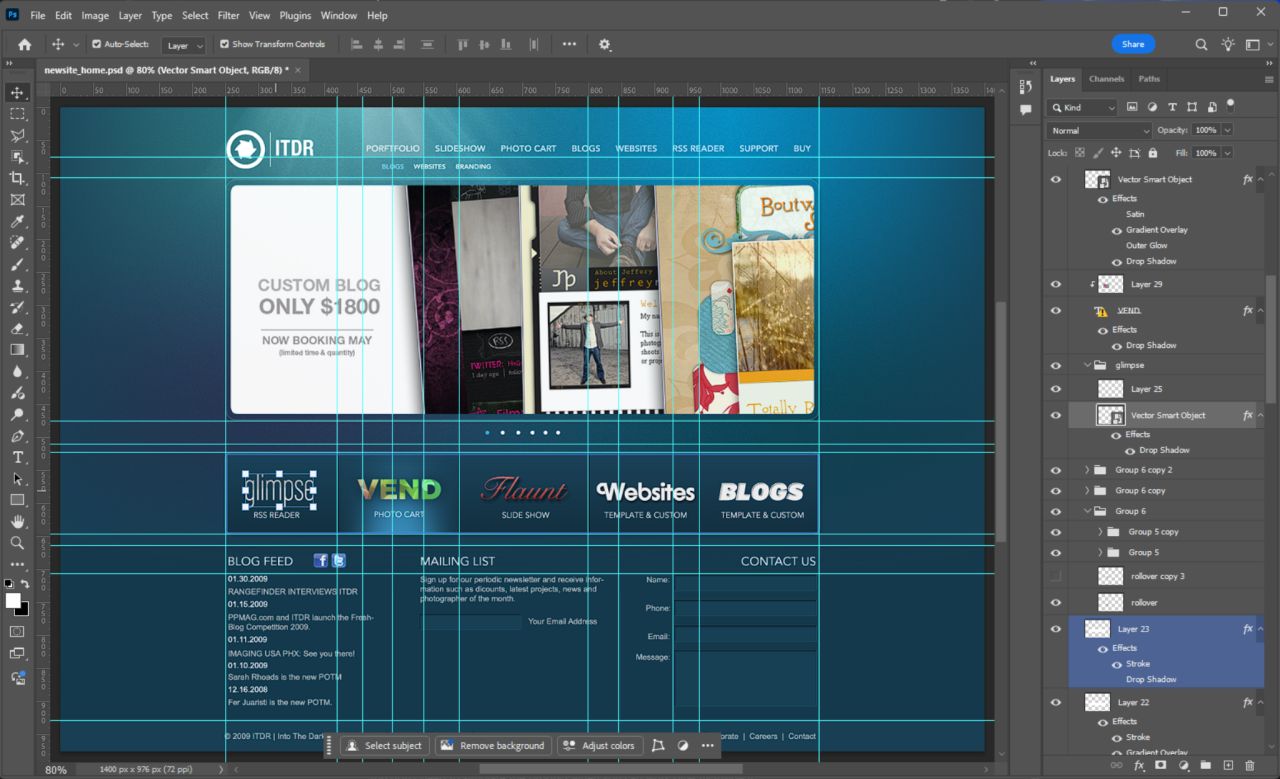
Look at an old web design PSD and you can practically see the entire production process. The guides establish the grid. The layers separate the interface into pieces. Each visual decision is made against a particular canvas size. Once approved, the next job is to translate that picture into something a browser can render.
For years, that was simply how we worked.
And even after websites stopped being quite so image-heavy, Photoshop remained useful. We still needed to crop, export, compress, and prepare images for the constraints of the browser. Somebody had to produce the assets, and somebody had to make sure they weren’t enormous.
The web stopped being a collection of images
Over time, both sides of that workflow changed.
On the asset side, a lot of what we once prepared by hand became routine infrastructure. Image optimization services such as ShortPixel automated compression. Image CDNs could resize assets and serve formats like WebP or AVIF based on the request. SVG replaced whole categories of icons and decorative graphics. CSS became capable of handling visual treatments we once would have exported as images.
That’s a tremendous amount of Photoshop work that simply doesn’t need to happen anymore.
Of course, images haven’t disappeared. Photography, illustration, and high-end image editing still matter. But an interface doesn’t need to be assembled out of raster assets just because that’s how we used to design one.
And when an image is part of the system, the workflow is increasingly about managing it correctly at delivery time. Anyone who’s dealt with a 10 MB PNG uploaded to a CMS for use as a 50-pixel logo understands the problem.
The editor used to be responsible for preparing the image. Now the application and its delivery pipeline can take on much more of that work.
The design stopped being a fixed picture
The other change was more fundamental.
Websites became responsive, component-driven, and full of content that changes. A static design could describe one version of a page, but the real site had to survive every viewport, every awkward headline, every unexpected image, and every state a user could put it in.
The more dynamic the interface became, the less authority a single perfect mockup could have.
Tools like Sketch and Figma formalized that shift. Design moved toward reusable components, shared styles, and systems rather than a collection of finished pictures. Those tools still create representations of interfaces, but they do a much better job of accounting for the fact that the same pieces need to work together across an entire product.
Meanwhile, the browser became a far better design environment in its own right. Modern CSS, layout systems, and frameworks such as Bootstrap and Tailwind make it practical to build and adjust much of the interface directly where it will actually run.
This is where my own role changed, too. I’ve moved away from producing the design layer and closer to building the system itself. These days, it’s generally Figma or nothing at all. I can’t remember the last time I genuinely needed to open a PSD for a web project.
The expensive part was translating the picture
There’s something inefficient about designing an entire interface in one application and then rebuilding it in another medium.
First, you create a picture of the product. Then you translate that picture into HTML, CSS, JavaScript, templates, and content. Then the real product starts behaving in ways the picture never accounted for.
A button needs another state. A headline wraps differently. The content team adds a longer title. The layout changes at a breakpoint. Suddenly, the approved mockup is no longer an accurate representation of what exists.
None of that means visual design is unnecessary. It means that a static picture is a poor place to maintain the truth about a dynamic system.
When you can work directly with actual components, actual content, and actual browser behavior, you remove an entire round of translation. The page itself tells you whether the idea works.
That changes where the effort goes: less time maintaining representations, more time shaping the thing people will actually use.
This isn’t an argument against visual design or prototyping. It’s an argument against treating a static mockup as the final authority for a system that is inherently fluid.
Photoshop didn’t fail. The workflow moved.
I have no interest in arguing that Photoshop is obsolete. It isn’t. For photography, compositing, retouching, and a hundred other kinds of visual work, it remains an extraordinary tool.
But those aren’t the jobs I’m spending my days doing.
For the kinds of websites and applications I build now, the meaningful decisions happen in the code, the component system, the content model, and the browser. A Photoshop document would mostly be an extra step between an idea and the place where that idea has to work.
I didn’t cancel because I stopped appreciating the software. I canceled because I stopped needing that step.
Tools don’t disappear because they fail. They disappear when the layer they serve collapses.
That’s what this feels like after almost three decades.
Not because Photoshop isn’t good.
Because the workflow moved.